Why Indigenous Literatures Matter by Daniel Heath Justice
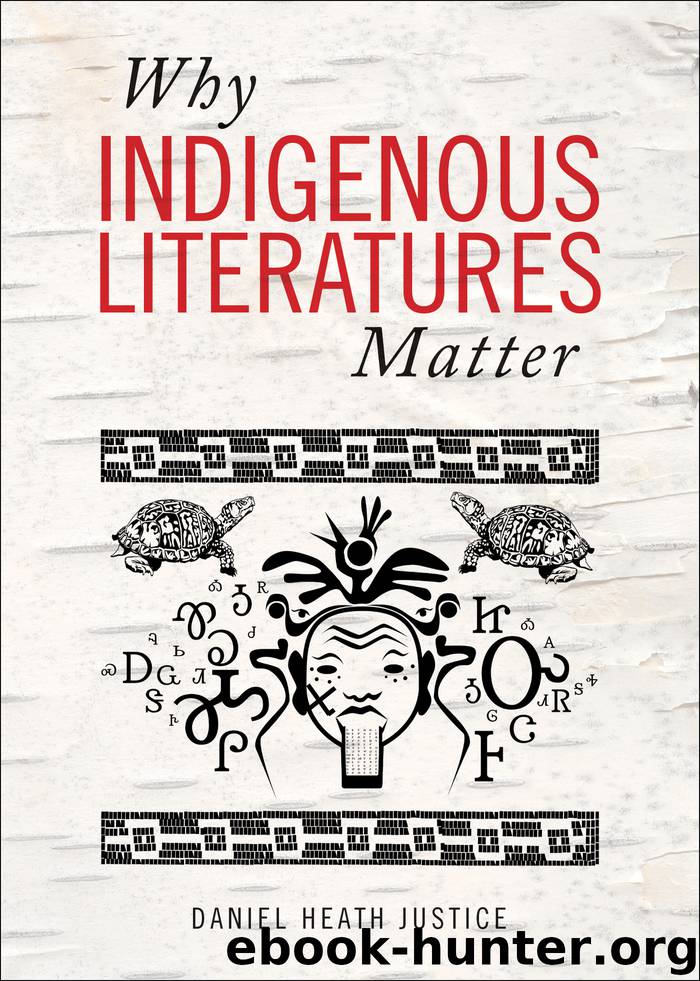
Author:Daniel Heath Justice
Language: eng
Format: epub
Publisher: Wilfrid Laurier University Press
Published: 2018-03-29T04:00:00+00:00
Chapter 4
How Do We Learn to Live Together?
Have you got it? You got it, right? And now I want you to act on it. And tell your friends, and tell your friends to tell their friends, and tell their friends to tell their friends. That way we can all live together like a nice big happy family!
—WAAWAATE FOBISTER, AGOKWE
Of all the vital commitments we have in this life, figuring out how to live together is the one we spend the most of our time and attention trying to figure out. It’s at least partly why we have custom, law, protocol, diplomacy, education, economies, and so on—these are all deeply concerned with sorting out ways of living together, or, more often, trying to manage the complexities of our inabilities to do so. How we become human, how we behave as good relatives, how we become good ancestors—all of these concerns are, in part, about living together within the context of autonomous identities in relationship.
If relationship is the central ethos of Indigenous literature, then we must consider how these works articulate existing relational concerns and offer new possibilities, fresh perspectives on existing conflicts and struggles. Yet it’s not only the question of Indigenous and newcomer co-existence that requires consideration, it’s living with one another as Indigenous peoples, with our human and other-than-human kin, with our ancestors and those beings of worlds beyond our own, including those of the future. While grappling with the intrusions and catastrophes and possibilities of living with and among colonial populations while retaining our own ways, priorities, and relations, we must always be wary of giving priority to this narrow context at the exclusion of the others.
This focus is difficult to achieve in the current moment in Canada, where “reconciliation” has become something of a phenomenon in the aftermath of the Truth and Reconciliation Commission’s searing final report and transformative calls to action. Yet it’s telling that the singular term “reconciliation” has become the shorthand form of what was originally conceived as the compound “truth and reconciliation.” Truth has been largely dropped from the discussion, at least on the part of settler Canada—not surprisingly, given this country’s longstanding commitment to historical amnesia when it comes to Indigenous issues, as with the almost entirely unfulfilled promise of the Royal Commission on Aboriginal Peoples from the 1990s. Without truth, of course, reconciliation can only be surrender to the status quo, as it’s devoid of the accountability that comes from hearing, embracing, and answering to the truth. For Indigenous survivors of the residential schools, their families, and their supporters, reconciliation was always intended to be an active and ongoing relationship; for the Canadian government and many Canadians, reconciliation was a one-time process that made financial amends, a few good speeches, and then moved on to business as usual. When resource extraction companies have reconciliation liaisons and hard-right evangelical churches use reconciliation as the rationale for their renewed vilification of traditional values and traditions, we know the term is increasingly devoid of significance—even dangerous.
Download
This site does not store any files on its server. We only index and link to content provided by other sites. Please contact the content providers to delete copyright contents if any and email us, we'll remove relevant links or contents immediately.
| Anthropology | Archaeology |
| Philosophy | Politics & Government |
| Social Sciences | Sociology |
| Women's Studies |
Cecilia; Or, Memoirs of an Heiress — Volume 1 by Fanny Burney(32527)
Cecilia; Or, Memoirs of an Heiress — Volume 2 by Fanny Burney(31928)
Cecilia; Or, Memoirs of an Heiress — Volume 3 by Fanny Burney(31915)
The Great Music City by Andrea Baker(31898)
We're Going to Need More Wine by Gabrielle Union(19020)
All the Missing Girls by Megan Miranda(15888)
Pimp by Iceberg Slim(14464)
Bombshells: Glamour Girls of a Lifetime by Sullivan Steve(14037)
For the Love of Europe by Rick Steves(13807)
Talking to Strangers by Malcolm Gladwell(13329)
Norse Mythology by Gaiman Neil(13314)
Fifty Shades Freed by E L James(13215)
Mindhunter: Inside the FBI's Elite Serial Crime Unit by John E. Douglas & Mark Olshaker(9289)
Crazy Rich Asians by Kevin Kwan(9261)
The Lost Art of Listening by Michael P. Nichols(7475)
Enlightenment Now: The Case for Reason, Science, Humanism, and Progress by Steven Pinker(7287)
The Four Agreements by Don Miguel Ruiz(6727)
Bad Blood by John Carreyrou(6599)
Weapons of Math Destruction by Cathy O'Neil(6248)
